Best Neckband Headphones
Read this detailed post and explore more stories from our blog.
Every day we discuss the most interesting thingsdiscuss
Wednesday, Mar 11, 2026
Best Neckband Headphones in 2026: Sony vs JBL vs boAt Buying Guide
Neckband headphones are still one of the most practical audio options in 2026. While true wireless earbuds dominate marketing headlines, many users still prefer wireless neckband Bluetooth headphones because they offer longer battery life, better stability during workouts, and lower prices.
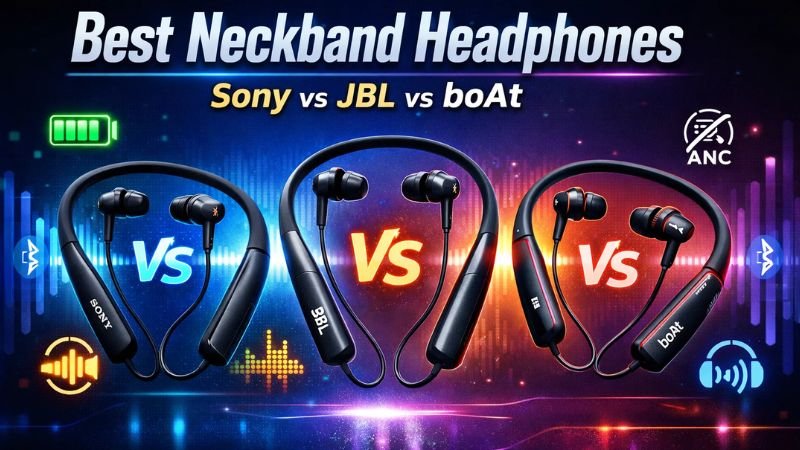
In 2026, the category has genuinely matured. The sound quality has improved across the board, fast charging is now standard on most decent models, and the top brands have worked out what their customers actually need.
In this guide, we compare the best neckband Bluetooth headphones from Sony, JBL, and boAt - the three brands that dominate this space - so you can buy from Amazon, Flipkart, Reliance Digital with confidence and stop second-guessing your shortlist. Whether you want wireless neckband headphones for the gym, the journey, or long days at a desk, there's a clear answer for every situation. Let's get into it.
Best Neckband Headphones in 2026 - Quick Picks
If you're short on time, here's where the research lands:
| Category | Product |
|---|---|
| Best Overall | Sony WI-C100 |
| Best Battery Life | boAt Rockerz 255 Pro+ |
| Best Sound Quality | JBL Tune 215BT |
| Best Budget | boAt Rockerz 235 |
| Best for Calls | Sony WI-XB400 |
| Best for Working Out | JBL Endurance Run 2 |
| Best ANC | Sony WI-1000XM2 |
What Are Neckband Headphones and Why Do People Use Them?
Neckband headphones are wireless earphones where two earbuds are connected by a flexible band that rests around the back of your neck. Unlike true wireless earbuds that are completely separate, neckband models keep the buds tethered together - which means you lose one, you lose both, and that almost never happens.
The band itself usually houses the battery, the controls, and the Bluetooth chip. That design choice is actually why neckband headphones tend to last longer on a single charge than true wireless alternatives - there's simply more physical space for a bigger battery.
People gravitate toward them for a few solid reasons. They're more stable during physical activity than standard earbuds. They're harder to misplace. The magnetic tips on most models click together and pause your audio automatically when you pull them off. And they tend to sit at a more accessible price point than premium true wireless options with comparable sound quality.
The crowd that uses them most? Gym-goers, cyclists, people on long work calls, and daily travellers who want something reliable without the paranoia of carrying tiny pods that cost as much as a phone.
Top 7 Best Neckband Bluetooth Headphones - Detailed Reviews
1. Sony WI-C100 - Best Sony Neckband Headphones Overall
If you want one pair of Sony neckband headphones that handles everything without asking too much of your wallet, the WI-C100 is the answer. Sony has packed a genuinely impressive amount of their audio engineering into this model, and it shows from the first listen.
The 9mm drivers deliver a balanced sound signature - clear mids, a decent low end that doesn't overpower, and highs that stay controlled rather than shrill on extended listening. Where neckband Bluetooth headphones Sony models have always had an edge is in the processing, and the WI-C100 continues that tradition with DSEE audio upscaling that makes compressed streaming files sound noticeably cleaner.
Battery life sits at 25 hours, which puts most of the competition to shame. The 360 Reality Audio support is a bonus if you use compatible streaming services, but the core listening experience holds up well on standard Spotify streams, too.
- Pros: 25-hour battery, balanced sound, IPX4 water resistance, lightweight build
- Cons: No active noise cancellation, mic is functional but not outstanding
- Battery life: 25 hours
- Best for: Daily travellers, office use, general listening
2. boAt Rockerz 255 Pro+ - Best Budget Neckband Headphones
The boat neckband headphones story is essentially the Rockerz 255 Pro+ story. This is the model that proved budget neckband headphones don't have to feel like a compromise, and it remains one of the most purchased neckband models in its price category year after year.
Sixty hours of battery life. Read that again. At this price point, that number is almost unfair to the competition. ASAP Charge gives you a usable hour of playback from 10 minutes of charging, the magnetic earbuds click together satisfyingly and auto-pause your audio, and the IPX5 rating means sweat and light rain won't cause a problem.
Sound quality is v-shaped - bass and treble pushed forward, mids slightly recessed. For pop, hip-hop, and electronic music, it sounds energetic and fun. For podcasts or acoustic listening, it's a little less refined, but at this price, that's a reasonable trade.
The mic picks up more background noise than Sony equivalents, which is worth knowing if calls are a major use case. For music and workouts, the neckband headphones boat range is exceptional value.
- Pros: 60-hour battery, ASAP Charge, IPX5, magnetic auto-pause, strong value
- Cons: Mic struggles in noisy environments, v-shaped tuning is not for everyone
- Battery life: 60 hours
- Best for: Gym users, budget-conscious buyers, music listeners
3. JBL Tune 215BT - Best JBL Neckband Headphones for Sound
JBL neckband headphones have always been about energy, and the Tune 215BT is a clean expression of that philosophy. The 12.5mm drivers are among the largest in this category, and they produce a full, punchy sound with genuine bass presence that smaller-driver competitors can't quite match.
The JBL neckband Bluetooth headphones Tune series uses JBL's Pure Bass sound technology, which is a marketing term for something that actually holds up in practice - the low-frequency response is tight and controlled rather than just loud and bloated. Treble extension is good, and the soundstage feels wider than you'd expect from an in-ear format.
Battery life is 17 hours, which is solid without being exceptional. The flat cable design reduces tangling, and the overall build feels more premium than the price suggests. Call quality is reliable with the hands-free mic handling standard environments well.
- Pros: Powerful 12.5mm drivers, JBL Pure Bass, flat tangle-free cable, 17-hour battery
- Cons: No fast charging, no water resistance rating
- Battery life: 17 hours
- Best for: Bass lovers, music-first listeners, casual daily use
4. Sony WI-XB400 - Best Neckband Headphones for Calls
Among Bluetooth neckband headphones Sony options, the WI-XB400 stands out specifically for voice performance. The microphone setup is noticeably cleaner than most neckband competitors, handling call audio well in moderately noisy environments without the caller on the other end asking you to repeat yourself.
The Extra Bass driver tuning gives the low end more weight than the WI-C100, which suits bass-heavy music preferences while keeping the overall signature listenable. Battery comes in at 18 hours, and the lightweight build at 23 grams means you'll genuinely forget you're wearing it after the first hour.
- Pros: Excellent mic quality, Extra Bass sound, 18-hour battery, very lightweight
- Cons: Bass-heavy tuning won't suit everyone, no ANC
- Battery life: 18 hours
- Best for: Regular call users, remote workers, bass music fans
5. boAt Rockerz 235 - Best Budget boAt Neckband Headphones
The entry point of the neckband headphones boat range, the Rockerz 235 costs very little and delivers a surprising amount. Sound quality is basic but functional, the 8-hour battery gets most people through a full workday, and the build is light enough to wear comfortably for extended periods. Call quality is average. In quiet environments, it's perfectly usable.
For students, casual listeners, or anyone buying their first pair of neckband headphones, the 235 is a sensible starting point that won't sting if it gets lost or damaged.
- Pros: Very affordable entry price, lightweight, comfortable fit, decent passive noise isolation, reliable Bluetooth connectivity, good bass response for the price
- Cons: Only 8-hour battery life, mic struggles in noisy environments, build quality feels basic, no fast charging, no water resistance rating
- Battery life: 8 hours
- Best for:Students, first-time buyers, casual everyday listeners on a tight budget
6. JBL Endurance Run 2 - Best Neckband Bluetooth Headphones for Sports
Where the standard JBL neckband Bluetooth headphones Tune range is a daily listener, the Endurance Run 2 is built specifically for movement. JBL's Twistlock eartip system locks the bud in place as you rotate it, eliminating the slipping issue that affects most in-ear designs during high-intensity exercise. The PowerHook design also automatically pauses your music when you hang the earbuds around your neck.
IPX5 water resistance, a 10-hour battery, and a secure fit make this the most practical sports neckband JBL produces. Sound quality is secondary to function here - it's tuned for motivation rather than precision. JBL neckband headphones can be used primarily during exercise.
- Pros: Twistlock eartip system for secure sports fit, IPX5 water resistance, PowerHook auto-pause, energetic sound tuning for workouts, quick charge support
- Cons: Sound tuning is too bass-heavy for casual or analytical listening, the 10-hour battery is below average for the category, no ANC or passive isolation beyond fit
- Battery life: 10 hours
- Best for: Runners, gym users, cyclists, anyone who needs a neckband headphone fit that genuinely stays put during intense physical activity
7. Sony WI-1000XM2 - Best Noise Cancelling Neckband Headphones
The premium option in the Sony neckband headphones lineup. If noise cancelling neckband headphones are your priority, this is the model that actually delivers. Sony's QN1 HD Noise Cancelling processor - the same chip in their flagship over-ear headphones - handles consistent background noise better than any other neckband currently on the market. For frequent flyers and open-plan office workers, the upgrade cost is justifiable. Sound quality matches the price. The dual drivers - a dynamic driver for lows and a balanced armature for mids and highs - deliver a layered, detailed presentation that rewards attentive listening. Bass is controlled and deep, mids are clear and present, and the highs have extension without harshness.
The neck band itself is heavier than budget options, given the hardware it carries, but the build quality is immediately apparent - this feels like a product built to last several years of daily use rather than one built to hit a price point.
- Pros: Best-in-class ANC for the neckband format, dual-driver audio setup, LDAC high-res audio support, Ambient Sound mode, premium build quality, strong mic performance
- Cons: Significantly more expensive than other models on this list, heavier neckband due to hardware, 10-hour battery with ANC active is below average for the category
- Battery life: 10 hours (ANC on) / 16 hours (ANC off)
- Best for: Frequent flyers, daily travellers on busy public transport, open-plan office workers, anyone for whom noise cancelling neckband headphones performance is the non-negotiable priority
Sony vs JBL vs boAt Neckband Headphones - Brand Comparison
When you're comparing boat vs jbl vs sony at a brand level rather than individual model level, the differences become easier to navigate.
The sony vs jbl vs boat headphones debate really comes down to what you prioritise most. Here's the honest breakdown:
| Feature | Sony | JBL | boAt |
|---|---|---|---|
| Sound Quality | Excellent - balanced, refined | Very Good - energetic, bass-forward | Good - fun, v-shaped |
| Battery Life | Good (18–25 hrs) | Good (10–17 hrs) | Excellent (up to 60 hrs) |
| Noise Cancellation | Best in class (WI-1000XM2) | Passive only | Basic ANC on select models |
| Build Quality | Premium | Durable | Lightweight |
| Mic Quality | Excellent | Good | Average |
| Price Range | Mid to Premium | Mid-range | Budget to Mid |
| Best For | Audiophiles, travellers, call users | Gym, bass lovers, active use | Value buyers, casual listeners |
When you look at jbl vs boat vs sony headphones this way, no single brand wins everything - which is actually the point. Sony wins on quality and refinement. JBL wins on durability and bass energy. boAt wins on battery life and value. Match the brand to your actual usage, and the decision becomes straightforward.
The short answer is: for some people, absolutely. For others, not really.
Noise cancelling neckband headphones work differently from over-ear ANC headphones. The ear seal in an in-ear format is less complete, which limits how effectively active noise cancellation can suppress low-frequency sound. You won't get the full sensory bubble effect that a pair of Sony WH-1000XM5 over-ears delivers. What you do get is a meaningful reduction in consistent ambient noise - aircraft cabin pressure, train rumble, office HVAC, open-plan chatter.
If your daily environment involves extended exposure to any of those, the investment in ANC makes genuine sense. Sony's WI-1000XM2 is the only neckband model where the ANC is truly impressive. boAt's ANC implementation on their higher-end models is more of a marketing feature than a functional one. JBL's Endurance range offers good passive isolation through fit rather than active cancellation.
If you travel daily on public transport or travel regularly for work, budget for the Sony. If your environment is reasonably quiet, save the money and spend it on better drivers.
How to Wear Neckband Headphones Properly
How to wear neckband headphones correctly is a question worth answering properly because a surprising number of people get this wrong and then wonder why their headphones feel uncomfortable or keep falling out.
- The band goes behind your neck - not over the top of your head. The curved or flat section rests against the back of your neck, sitting just above your collar. The cables run up either side toward your ears, and the earbuds insert at a slight forward angle rather than straight in. That angled insertion is the detail most people miss. When you angle the bud slightly forward before pressing in, you get a proper seal, which dramatically improves both bass response and passive noise isolation.
- For sports use, tuck the cable lightly under your shirt collar or use the included clip if one is provided. This stops the cable bouncing against your jaw during movement, which is one of the more irritating neckband-wearing experiences if you don't manage it proactively.
- Neckband over ear headphones - hybrid designs where the band passes over the ear rather than behind the neck - are more stable for intense activity but less comfortable over long periods. For most daily use cases, the standard behind-the-neck style is the better choice.
- Magnetic earbuds, which are a feature on most mid-range and above models, click together when you pull them out. Most models auto-pause your audio when the magnets connect - a small but genuinely useful feature you'll miss if you ever switch to a model without it.
Wireless Neckband Headphones vs True Wireless Earbuds - Which Is Right for You?
| Features | Wireless Neckband Headphones | True Wireless Earbuds |
|---|---|---|
| Battery Life | 15–60 hours | 5–8 hours (buds only) |
| Risk of Loss | Very low | Higher |
| Stability During Exercise | Excellent | Variable |
| Charging Case Required | No | Yes |
| Price for Same Quality | Lower | Higher |
| Premium Sound Options | Good | Excellent |
Bluetooth wireless neckband headphones win on battery life and practicality. True wireless earbuds win on premium audio engineering and form factor. If you've lost earbuds before, hate carrying a charging case, or need a full-day battery without thinking about it, neckband is your format. If you want the absolute cutting edge in audio technology and don't mind managing the battery more carefully, true wireless is worth exploring.
Buying Guide - How to Choose the Best Neckband Bluetooth Headphones
Before we get into specific brands and models, here's what you should look for while comparing the best neckband headphones on the market.
- Battery life should be your first filter. Under 15 hours in 2026 is below average for this category. Look for 20+ hours as a baseline.
- Bluetooth version matters for stability and range. Bluetooth 5.0 and above offer stronger connectivity, lower latency, and better power efficiency than older versions.
- Water resistance - IPX4 handles sweat and light rain. IPX5 handles direct water spray. For gym use, anything below IPX4 is a risk.
- Driver size determines how much air moves and, therefore, how full your bass sounds. Larger drivers - 10mm to 13mm - generally outperform smaller ones in low-frequency response.
- Fast charging is no longer a premium feature - most decent models offer it. Ten minutes of charging for an hour of playback is the standard benchmark worth looking for.
- Codec support - if your phone supports aptX or LDAC, make sure your headphones do too. The difference in audio quality on a supported codec connection is audible, particularly in the high-frequency detail.
- Microphone quality is underrated. If you use your Bluetooth wireless neckband headphones for calls, look for models with noise-isolating or beamforming microphone tech.
Who Should Buy Neckband Headphones?
- Travellers get the most obvious benefit - long battery life, hands-free calling, and a secure fit that doesn't require constant adjustment on crowded transport.
- Gym users appreciate the stability of the neckband format during exercise, the sweat resistance on most models, and the motivating sound signatures that brands like JBL tune their products for.
- Remote workers and call-heavy professionals benefit from the consistently reliable mic quality across Sony's range and the comfort of a lightweight neckband during hours-long call days.
- Budget shoppers who want genuinely good audio without paying true wireless prices will find more value per rupee or dollar in the neckband category than almost anywhere else in personal audio right now.
Where to Get the Best Deals on Neckband Headphones
Before you hit buy, check MyCouponStock for the latest verified discount codes across Sony, JBL, and boAt. All three brands run regular sale events - boAt in particular drops significant discounts around Indian sale seasons - and a working promo code on a mid-range model can save you enough to justify going one tier higher in quality than your original budget allowed. We update deals daily, so bookmark the page and check back before making any purchase.
Final Verdict - Which Neckband Headphones Should You Buy?
If you are buying Bluetooth neckband headphones, then buy one that sounds good and lasts through your day.
- Best overall: Sony WI-C100 - the most complete package at a reasonable price. Balanced sound, 25-hour battery, reliable build.
- Best budget: boAt Rockerz 255 Pro+ - 60 hours of battery and ASAP Charge at a price that's hard to argue with.
- Best sound: JBL Tune 215BT - if bass and energy matter more than neutrality, JBL wins this one.
- Best premium: Sony WI-1000XM2 - the only neckband headphones with ANC that actually perform.
Frequently Asked Questions (FAQs)
Are neckband headphones better than earbuds?
For battery life, stability during physical activity, and value, neckband headphones outperform true wireless earbuds in most practical daily scenarios. Earbuds win on premium sound engineering and portability.
Which brand makes the best neckband headphones?
Sony leads in sound quality and call performance. JBL leads in sports durability and bass energy. boAt leads in battery life and value. The best brand depends on what you use headphones for most.
Are Sony neckband headphones worth it?
Yes - particularly the WI-C100 for everyday use and the WI-1000XM2 if noise cancellation matters. Sony neckband headphones consistently outperform similarly priced alternatives in mic quality and audio refinement.
Are boAt neckband headphones good?
For the price, they're excellent. The Rockerz 255 Pro+ specifically offers battery life and features that no competitor matches at the same cost. Build quality and mic performance are the only areas where premium brands pull ahead.
Do neckband headphones support noise cancelling?
Some do. Noise cancelling neckband headphones are a smaller subset of the category - Sony's WI-1000XM2 is the most effective implementation. Most neckband models rely on passive noise isolation through eartip seal rather than active cancellation.
What is the battery life on most neckband headphones?
It varies significantly. Budget models typically offer 8–15 hours. Mid-range wireless neckband headphones deliver 17–25 hours. boAt's Rockerz 255 Pro+ tops the category at 60 hours, which remains genuinely exceptional for any personal audio product at its price point.
All Blogs

Why Gen Z Is Ditching For The Beauty Ana..
Makeup Why Gen Z Is Ditching Doomscrolling For The Beauty An...
Nike vs Adidas: Which Brand Has Better D..
Shopping Guides • Published on mycouponstock Nike vs. Adidas...

America's most (and least) deal-obsessed..
America's most (and least) deal-obsessed cities: A study of ...
Cashback vs. Verified Codes: Why We Comp..
Cashback vs. Verified Codes: Why We Compete On Accuracy, Not...
Which Online Stores Offers Student Disco..
Which Online Stores Offer Student Discounts? We Analyzed Mil...

Top 5 Coupon Sites France, Germany, Ital..
The Top 5 coupon sites in France, Germany, Italy & Poland. F...

May Sale and Top Deals in USA..
Memorial Day Sale USA 2026: Best Online Stores Sale in USA M...

TPE vs Silicone Menstrual Cup..
TPE vs Silicone Menstrual Cup: A Complete Comparison for Fir...

The Ultimate Guide to Ramzan Offers..
The Ultimate Guide to Ramzan Offers 2026 Top Sales, Discount...

Best Cream for Pimples and Dark Spots..
Best Cream for Pimples and Dark Spots - Where to Buy Them fo...